Updated . FinCEN dropped its 2023 mixing rule this month, and all six BTC mixers were re-rated for late October.

Best BTC Mixers in 2026, Refreshed for Late October

Welcome to Best BTC Mixers, glad you stopped by. Today we’ll walk you through the bitcoin mixers that are actually worth your coins this autumn: what each one charges, where it falls short and which one we’d pick for which job.

New to all this? No problem. We start from the basics, explain how a bitcoin mixer works in plain words and finish with the simple routine we use ourselves. Grab a coffee, it’s a short read.

Explore the top picks ›
0.7%
Lowest listed fee
168 h
Longest delay
20
Max payout addresses

Out this month

Fresh This Week: What Changed for Coin Mixing in October 2026

Before the ranking, a quick catch-up. Three things happened over the last few weeks that matter if you’re choosing a BTC mixer today, and all of it is current as of October 29.

, regulation, US

FinCEN withdraws its 2023 mixing rule

On October 5 the Treasury's anti-money-laundering unit said it was pulling the Section 311 proposal that would have labelled international crypto mixing a primary money-laundering concern. The withdrawal was published the next day. FinCEN's own reasoning: the definition of mixing was so wide it could chill lawful activity and bury banks in reports. It also said it will keep watching for abuse.

Status: withdrawn

, regulation, US

Self-hosted wallet reporting is off the table

The same notice killed the 2020 proposal that would have made banks and money transmitters log larger transfers to self-custody wallets and verify who owns them. It never took effect, but it hung over every withdrawal to a personal wallet for six years. Mixing into your own wallet no longer runs into that shadow.

Status: withdrawn

, CoinJoin

CoinJoin is back above its 2024 level

Wasabi Wallet 2.8.3 shipped in mid-September and runs fine without zkSNACKs, the coordinator that shut down in June 2024. A 2026 Masaryk University study published in PoPETs found Wasabi CoinJoin activity has climbed past where it was before that shutdown. Non-custodial mixing is healthier today than it looked a year ago.

Latest: v2.8.3

Our ranking

Top Bitcoin Mixers Right Now

Now the part most of you came for. These six top BTC mixers made our cut this month. We scored each one on fee transparency, control over delays and payout splits, signed guarantees, Tor access and track record. Fees and limits are the ones each service lists in October 2026.

  1. 1. Best overall

    Mixero

    9.6/10

    Two modes in one place. Standard mixing is CoinJoin-based and costs 0.7% plus a fixed 0.0003 BTC. Advanced mode routes coins through Monero and back to BTC, starting at 1.6% and rising to 4.7% if you want priority. You can hold the payout for up to 168 hours and split it over five addresses, and the same service also handles ETH.

    0.7% + 0.0003 BTC
    Fee
    0.002 BTC
    Minimum
    up to 168 h
    Delay
    up to 5
    Outputs

    Monero route for the hard casesAdvanced mode costs more

  2. 2. Most control

    Anonymixer

    9.2/10

    You set the fee yourself, anywhere from 1% to 4%, and pick a delay between 1 and 48 hours. The payout can be spread over as many as 20 addresses, the widest range we found. Order data is wiped once the job completes, and the interface stays simple enough for a first-timer.

    1–4%, your choice
    Fee
    0.001 BTC
    Minimum
    1–48 h
    Delay
    up to 20
    Outputs

    Widest payout splitBitcoin only

  3. 3. Longest track record

    Mixer.money

    8.9/10

    Running since 2016. The basic mode randomises its commission between 1% and 1.5% and finishes within about two hours for 0.001 to 1 BTC. "Complete anonymity" pays you out with coins sourced from exchanges, costs 4–5% and can take up to ten hours. There is a Tor mirror and a Telegram bot for starting orders.

    1–1.5% or 4–5%
    Fee
    0.001–1 BTC
    Range
    2 h, up to 10 h
    Time
    2016
    Since

    Randomised fee hides your order1 BTC cap in basic mode

  4. 4. Best non-custodial

    Wasabi Wallet

    8.8/10

    Not a custodial service at all, but a desktop wallet that CoinJoins them for you. Your keys never leave your machine, traffic runs over Tor by default and current releases only join rounds where you pay mining fees, with no coordinator cut. The trade-off is time: a solid anonymity score takes several rounds.

    mining fees only
    Fee
    5,000 sats
    Minimum
    your own keys
    Custody
    2.8.3
    Version

    Nobody holds your coinsSlower, desktop only

  5. 5. Fastest payout

    Whir

    8.7/10

    Whir is built around speed: payouts go out after a single confirmation. You still get manual delays, up to ten payout addresses and a PGP-signed letter of guarantee for every order. Each job is capped at 10 BTC, and Bitcoin Cash works alongside BTC.

    variable
    Fee
    0.001 BTC
    Minimum
    10 BTC
    Max order
    up to 10
    Outputs

    Signed guarantee on every order10 BTC ceiling

  6. 6. Flexible modes

    WebMixer

    8.5/10

    Three modes: Basic Anonymity, Exact Payment and Maximum Anonymity. The top tier cuts your coins into random parts and pays out from exchange liquidity, while Exact Payment is handy when a merchant expects a precise amount. Delays go up to six hours. No account, no KYC, Tor mirror included.

    by mode
    Fee
    0.001 BTC
    Minimum
    up to 6 h
    Delay
    3
    Modes

    Exact Payment modeTop tier gets pricey

Side by side

Bitcoin Mixer Comparison: Fees, Limits and Delays

Prefer numbers to paragraphs? Here is every bitcoin mixer from our ranking in one table. Fees move, so take a quick look at the order page before you send anything.

Comparison of the six reviewed mixing services, October 2026
Service Model Lowest fee Minimum, BTC Max delay, h Outputs Score
MixeroCustodial + CoinJoin, XMR route0.7% + 0.00030.00216859.6
AnonymixerCustodial1% (you pick 1–4)0.00148209.2
Mixer.moneyCustodial, two modes1–1.5% random0.00110not listed8.9
Wasabi WalletNon-custodial CoinJoinmining fees0.00005you decidemany, equal8.8
WhirCustodialvariable0.001manual108.7
WebMixerCustodial, three modesby mode0.0016random split8.5
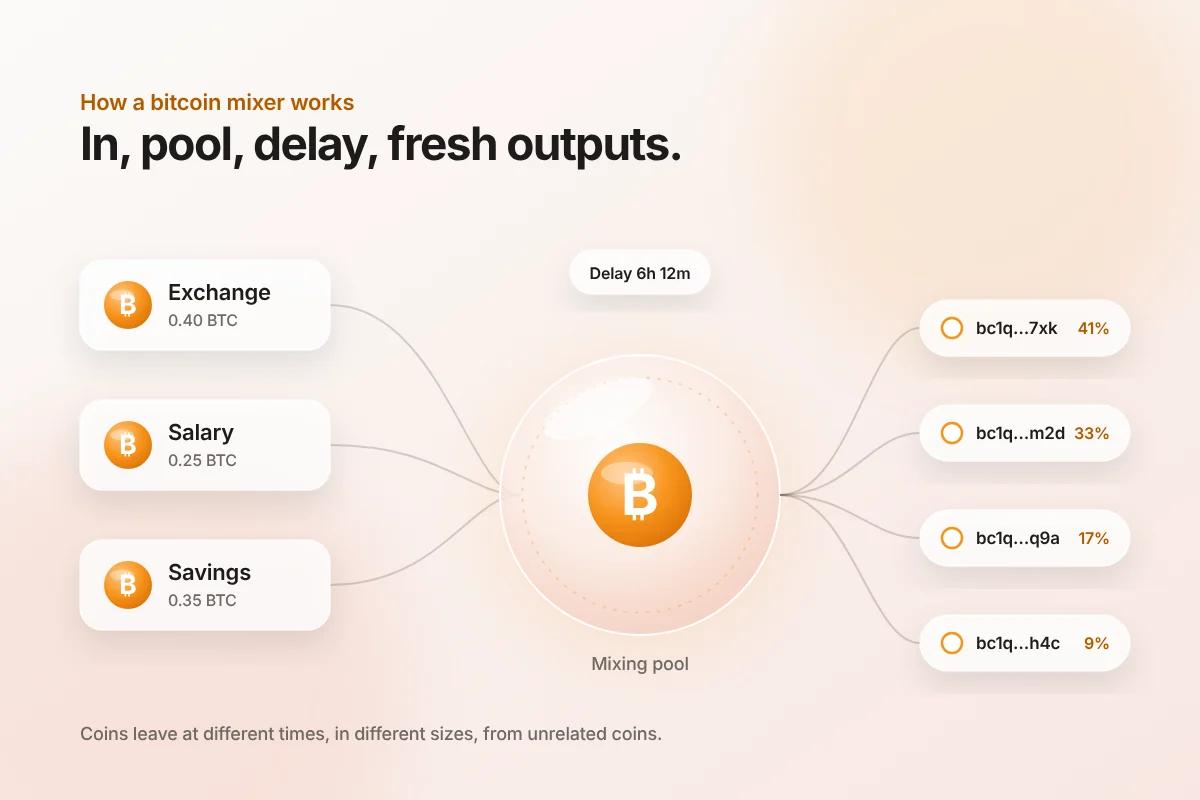
Diagram of how a bitcoin mixer pools inputs and pays out fresh outputs
Inputs go into a shared pool and leave as unrelated outputs, at different times and in different sizes.

The mechanics

How a Bitcoin Mixer Breaks the Trail

Picture a public spreadsheet of every payment ever made. Your exchange knows which row is yours, the shop you paid knows the next one, and an analytics firm fills in everything between. A custodial bitcoin mixer takes your coins into a large pool, then pays you from unrelated coins at new addresses, with random delays and split amounts so that timing and size don't give you away.

CoinJoin gets to the same place by another road. Dozens of people sign one shared transaction with equal-sized outputs, so nobody, the coordinator included, can say whose coin went where.

Mixing does not make coins invisible. It makes the link between in and out uncertain and expensive to prove. How expensive depends on the size of the pool, the delay you choose and whether you later undo the work by merging mixed coins with old ones.

Two approaches

Custodial BTC Mixers vs CoinJoin Wallets

Every service on this page fits one of two models, and the difference decides who holds your coins while they are being mixed.

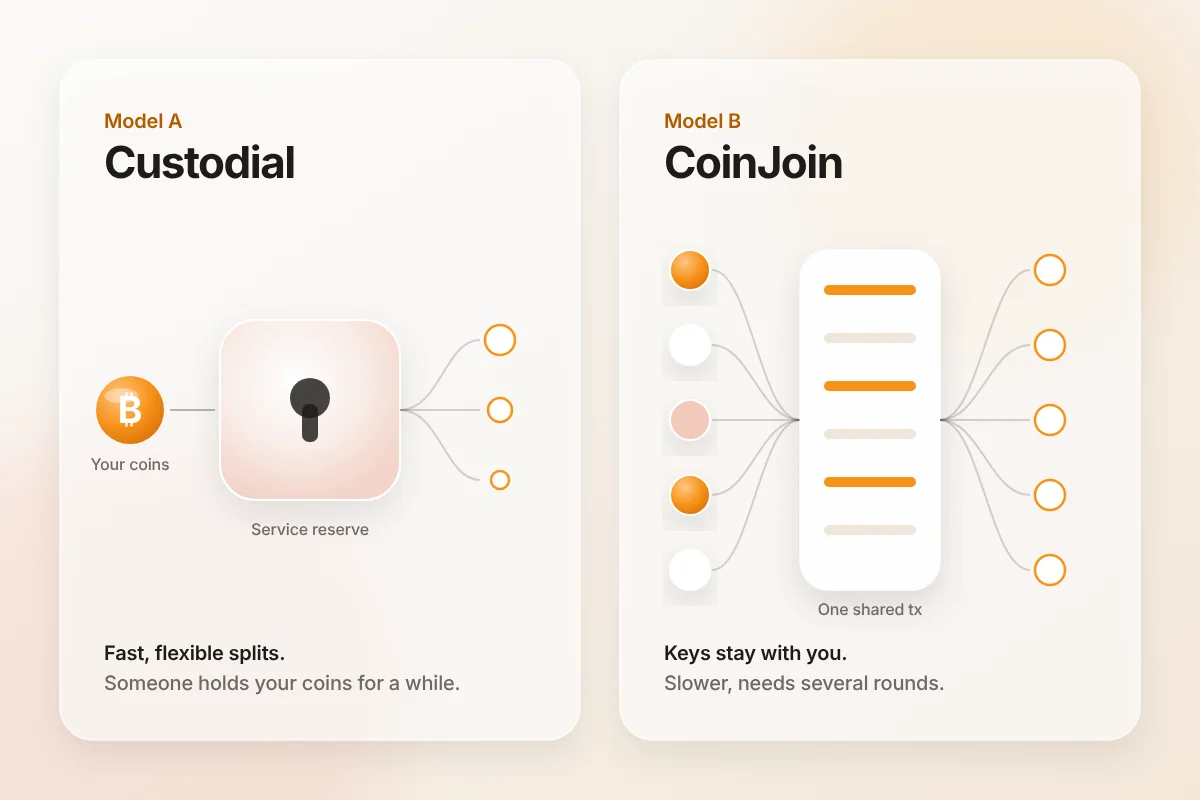
Model A

Custodial tumbler

You send coins to the service and it pays you back from its own reserves. It's fast, works from any browser and gives you fine control over delays and splits. The catch is trust: for a few hours somebody else holds your money, so a signed guarantee and a long clean history matter more than anything on the homepage.

Pick it if you want a result today and a payout split across several wallets.

Model B

CoinJoin wallet

Your coins never leave your control. The wallet joins rounds with other users and everyone signs the same transaction. There is nobody to run off with your funds, but you pay with patience, a desktop install and some care about which coins you later spend together.

Pick it if custody risk is a deal-breaker and you can wait for a few rounds.

Custodial tumbler compared with a CoinJoin transaction

Honest trade-offs

Why People Mix Coins, and What Can Go Wrong

The typical user is not a hacker. It's a freelancer paid in BTC who doesn't want clients browsing their savings, someone who bought through a KYC exchange and wants that link gone before paying for everyday things, a donor to a cause that is sensitive at home, or a small business that would rather not expose supplier payments to competitors.

What you gain

  • Your balance and history stop being one click away for anyone you pay.
  • Address clustering by analytics tools gets far less reliable.
  • Old KYC records no longer point straight at today's spending.
  • Split payouts let you fund several wallets in one go.

What can go wrong

  • A custodial service can disappear with deposits.
  • Phishing clones copy the design and steal the coins.
  • Some exchanges flag or freeze deposits fresh from a mixer.
  • Careless spending afterwards can undo the whole thing.

Step by step

How to Use a BTC Mixer Safely

This is the routine we follow ourselves. It works with any of the best BTC mixers above and takes about ten minutes to set up.

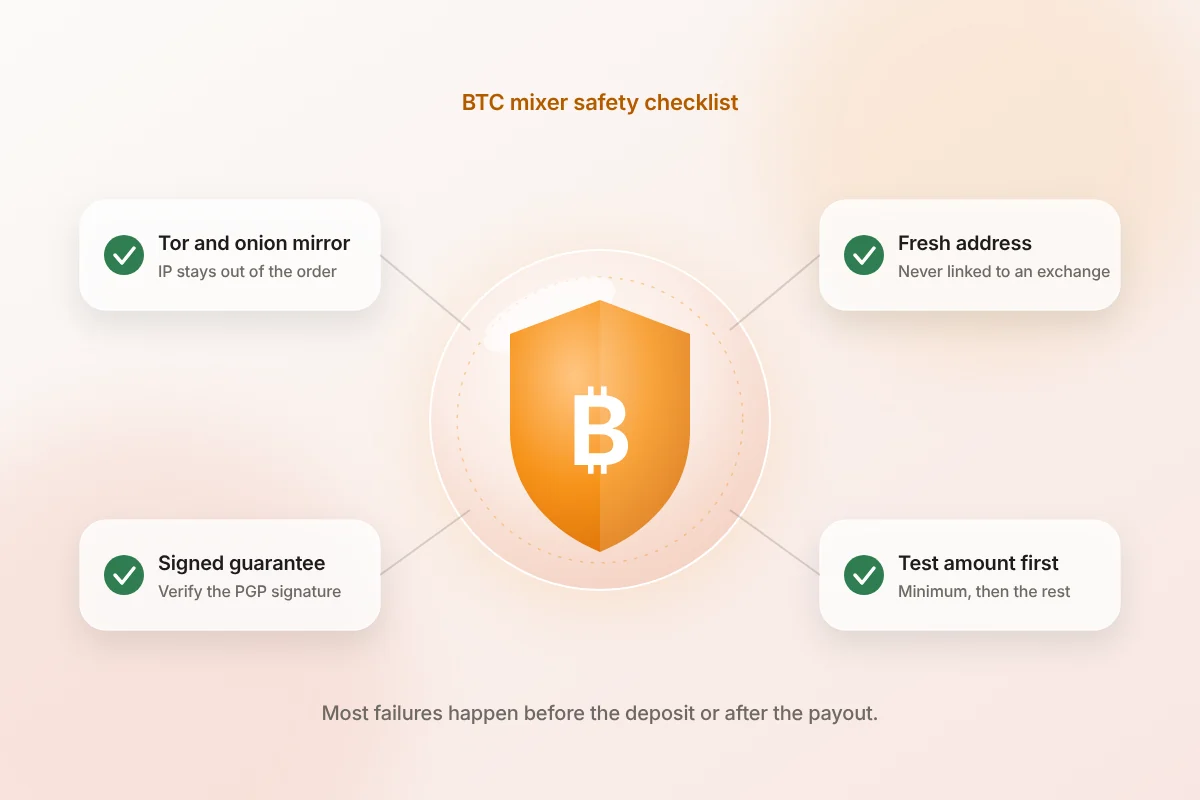
  1. Start clean. Open Tor Browser and use the service's onion mirror if it has one, so your IP never lands in the order.
  2. Prepare fresh addresses. Generate new receiving addresses in a wallet you control, ideally one that has never touched your exchange account.
  3. Set delay and split. Pick several hours of delay and uneven percentages per address. Random beats round every time.
  4. Save the letter of guarantee. Download it and check the signature against the service's published PGP key before you send a single satoshi.
  5. Send a test amount. Push the minimum through, wait for it to arrive, then send the rest.
  6. Keep mixed coins apart. Don't merge them with old coins and don't send them straight back to the exchange you started from.
Safety checklist for using a BTC mixer: Tor, fresh address, signed guarantee, test amount
Most failures happen before the deposit or after the payout, not inside the pool.

Picking your service

How to Choose Among the Best Bitcoin Mixers

Fee is the number everyone looks at first and the one that matters least. A cheap BTC mixer with a tiny pool gives you less cover than a pricier one with steady volume. Look at the four things below, in this order.

  1. Pool size and age

    Years of uninterrupted work and steady volume beat any marketing claim. New services with flashy sites are where exit scams live.

  2. Signed guarantee

    No PGP-signed letter, no deposit. It's the only proof you'll have if a payout goes missing.

  3. Delay and split control

    Fixed timing and one output make analysis easy. You want hours of delay and several uneven payouts.

  4. Official addresses

    Clones buy ads and copy layouts pixel for pixel. Bookmark the real domain and onion link, and never follow links from chats.

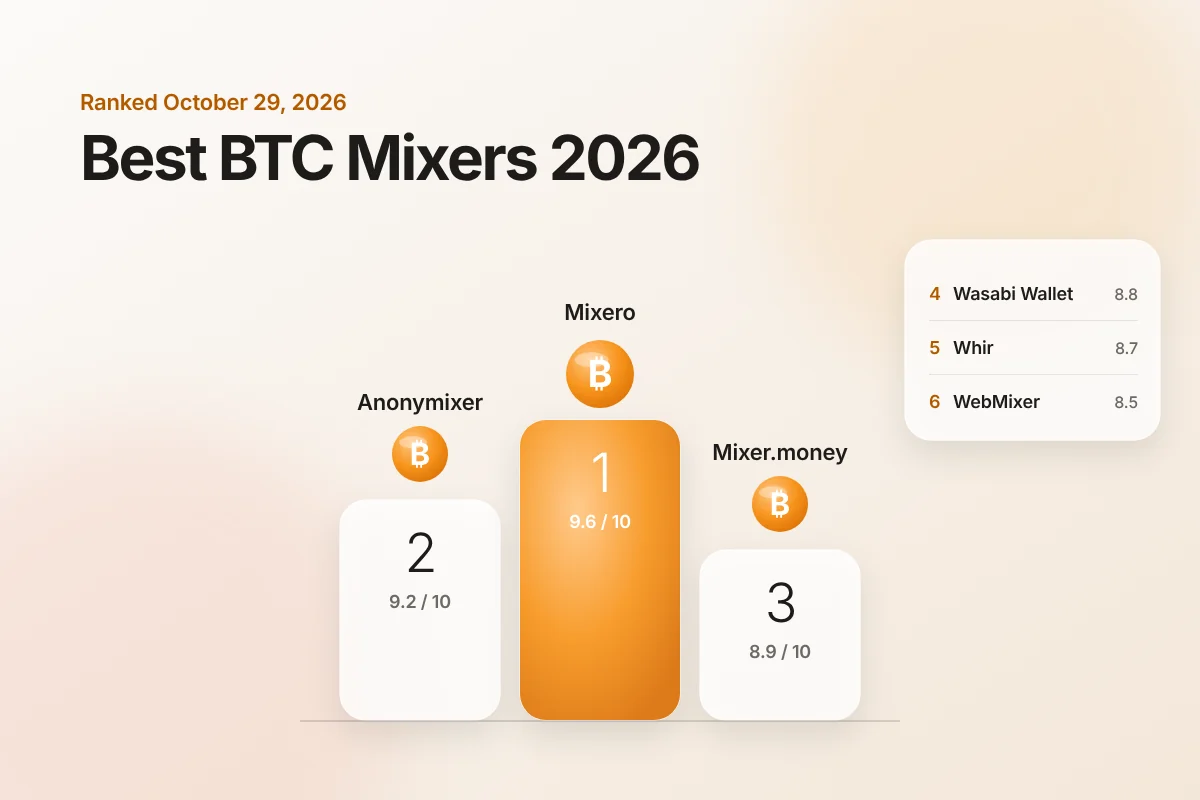
Best BTC mixers of 2026 ranked by score

Most people who get traced after mixing didn't lose to the mixer. They lost to their own habits afterwards: merging outputs, sending everything back to the same exchange account within a day, reusing an address. Pick a service with a real pool and a signed guarantee, then spend the coins the way a stranger would. FinCEN stepping back this month eases the pressure in the US, but exchanges still run their own risk scoring, so plan your exits before you plan your deposit.

Best BTC Mixers EditorialPrivacy Research Lead, best-btc-mixers.com

Quick answers

Bitcoin Mixer FAQ

The questions readers send us most often, answered in a sentence or three.

Are bitcoin mixers legal?

In most countries using one is not a crime in itself, while running an unlicensed one can be. In October 2026 FinCEN withdrew its proposed rule that would have treated international crypto mixing as a primary money-laundering concern. Local rules still differ, and exchanges may question deposits that come straight from a pool.

Which is the best BTC mixer right now?

For most people Mixero: a 0.7% base fee, delays of up to 168 hours, up to five payout addresses and an optional Monero route. If you never want to hand over custody, use Wasabi Wallet and its CoinJoin rounds instead.

How long does bitcoin mixing take?

Anywhere from one confirmation, roughly ten minutes, to several days. The delay you choose is the main factor. Longer, uneven delays make timing analysis much harder.

How much does a bitcoin mixer cost?

Custodial services on this list charge between about 0.7% and 5% plus network fees. Wasabi Wallet charges no coordinator fee in current releases, so you only pay mining fees for each round.

Can mixed coins still be traced?

Sometimes. Mixing makes the link between input and output uncertain and expensive to prove. Most people who get traced undo the work themselves by merging mixed outputs with old coins or sending everything back to the same exchange account.

What is a letter of guarantee?

A message signed with the service's PGP key confirming your deposit address and order terms. If the service fails to pay out, it is your proof that the order existed. Download it and verify the signature before you send coins.

Do I need Tor to use a mixer?

It is not required, but it is strongly recommended. Tor Browser and the service's onion mirror keep your IP address out of the order record and also protect you from many phishing clones.

Who runs this site

About Us and the Company Behind the Reviews

best-btc-mixers.com is an independent review site. We don't run a bitcoin mixer, we never take custody of anyone's coins and we don't accept payment for placement or scores. Rankings change only when the services, their terms or the rules around them change.

Operator details